
The 4-3-1: Introduction
Introduction: Why Formations Matter
When you watch a well-structured junior team play, it often looks like they just know where to be — and that’s no accident.
Formations help give players that sense of structure. At this age, it’s not about rigid systems or tactics for tactics’ sake. It’s about helping kids understand where to be, who to support, and how we work together as a team.
In my opinion, one of the best shapes to do that in 9-a-side football is the 4-3-1.
What Is the 4-3-1?
The 4-3-1 refers to our team’s basic shape when we don’t have the ball, and it looks like this:
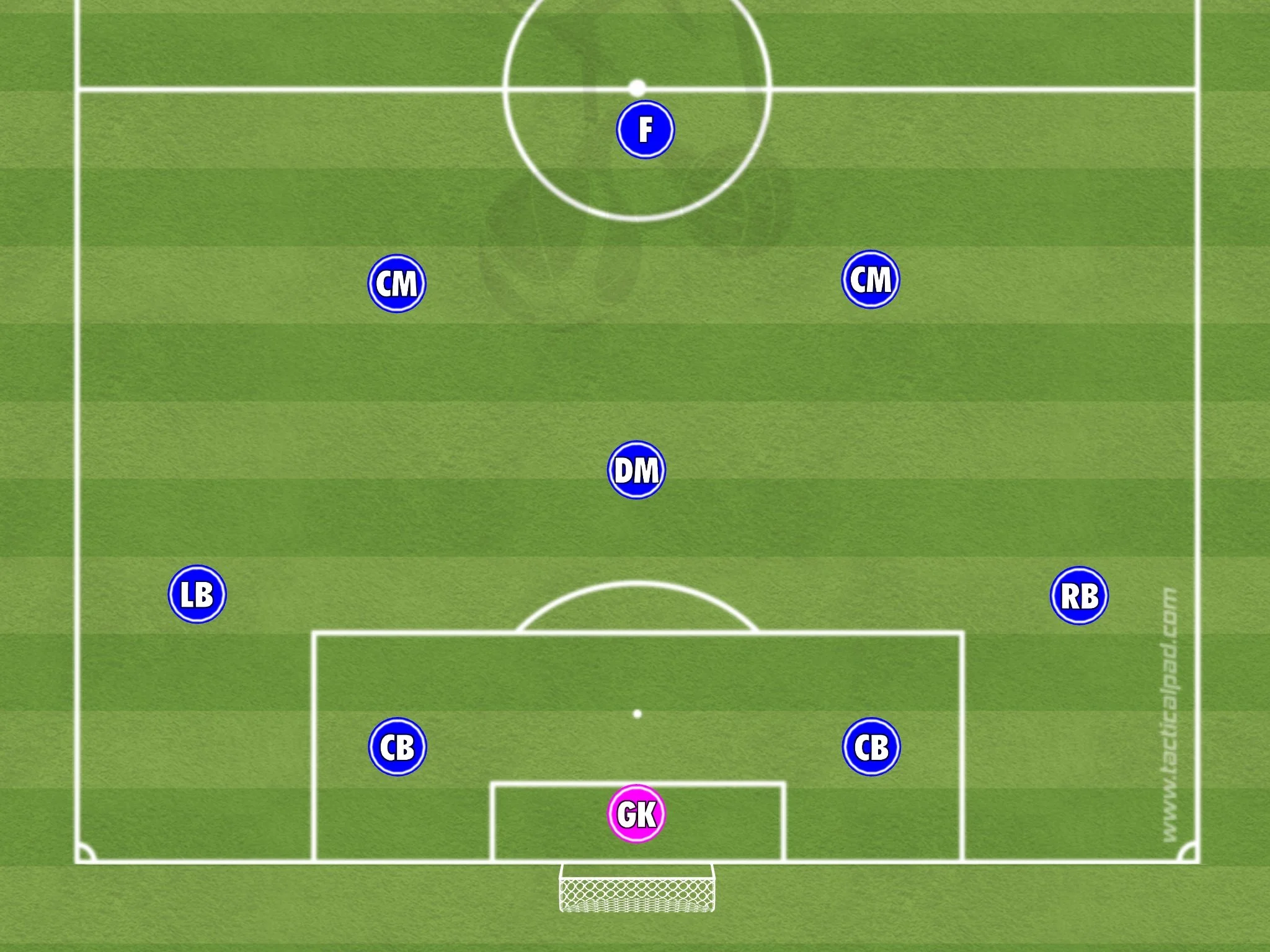
The 4-3-1 Formation
Positions:
Goalkeeper
4: 2x Centre Backs (CD) & 2x Wing Backs (WB)
3: Defensive Midfielder (DM) & 2x Central Midfielders (CM)
1: Striker (F)
You’ll notice that the team is built in layers, with each line contributing in different ways:
🛡 Defensive Players – 2 Centre Backs and 1 Defensive Midfielder
Centre Backs: Form the base of a strong defensive triangle. One engages while the other provides cover.
Defensive Midfielder: Sits at the top of the triangle and often engages the attacker first, protecting the space in front of the defence.
♻️ Supporting Players – 2 Wing-Backs and 2 Central Midfielders
Wingbacks: Provide width down both flanks. They are vital for defending wide areas and stretching the play in attack.
Central Midfielders: Help defensively through the middle and support attacking moves in transition. They often link defence to attack.
🎯 Attacking Player – 1 Striker
Striker: Leads the press when we don’t have the ball and looks to finish attacking moves when we do.
This layered structure gives us balance in all phases — helping us defend as a unit, build from the back, and support the striker without losing shape.
How It Links to 7v7: A Natural Progression
Many teams play a 2-3-1 in 7v7. The 4-3-1 builds on that shape — adding two midfielders ahead of the DMC
This keeps things familiar while allowing for more passing combinations, balance, and support — all of which are key at this stage of development.
Why Do We Use the 4-3-1?
When we moved to 9-a-side, a lot of coaches recommended the 3-2-3. That’s how we started — and yes, the results were positive. But something didn’t sit right. We were winning games, but I didn’t feel we were actually learning how to play football.
Why We Moved Away from the 3-2-3
My experience with the 3-2-3 was that the football looked good on the scoreboard, but not on the pitch.
The central centre back often stood directly in front of the goalkeeper, with little to do except clear long.
In midfield, we typically had one attacking and one defending midfielder, but this often lead to a disjoined team - 4 defenders and 4 attackers - leaving a big gap in the middle
The defending midfielder and central centre back often had overlapping roles
And with four attacking players ahead, we often skipped the build-up entirely — defenders would win the ball and launch it forward, hoping our attackers could chase and score.
It felt more like basketball than football — end-to-end, bypassing the midfield, hoping for moments of chaos up top. We struggled to pass consistently or defend well — but we were winning, so it was easy to ignore.
Eventually, I realised: the formation was hiding the gaps in our development.
What the 4-3-1 Teaches
We moved to the 4-3-1 not because it was fashionable, but because it gave us a clearer structure — and a better environment for learning.
Here’s what it offers:
Two Centre Backs: Develop a true partnership. They learn when to engage, when to cover, and how to stay connected.
Defensive Midfielder: Becomes the anchor. Learns to read play, delay attacks, and link defence to midfield.
Two Central Midfielders: Proper number 8s — required to work both ways, support attacks, and recover quickly.
Two Wing-Backs: Learn to dribble, recover, forward runs, and understand wide positioning — it’s demanding, but modern.
Striker: a complete forward — learning how to press, drop deep, play with their back to goal, and make runs in behind.
This structure doesn’t allow players to hide — and that’s a good thing. It gives them real decision-making responsibility and teaches them how to connect with others across the pitch.
What Are the Weaknesses of the 4-3-1?
No formation is perfect — and the 4-3-1 comes with its own challenges:
The striker can become isolated, especially if midfielders don’t support quickly in transition.
Wing-backs have a huge workload — they’re expected to defend deep and also provide attacking width.
There’s no natural wide attacker, so wing-backs must time their runs carefully, or the attack can feel narrow.
Midfield spacing can break down if players don’t stay connected
But for me, these are coaching challenges, not reasons to avoid the shape. They give coaches teachable moments — and that’s where the real learning happens.
🧠 Coach’s Note:
“We didn’t choose the 4-3-1 just because it looked balanced on paper. We switched to it because it better supported player development. Yes, it has flaws — but every formation does. The difference is, these weaknesses force us to solve problems together. And that’s what the game is really about. We don’t always get it right. But this formation has helped us play better football. It teaches the game in layers — from defence, to midfield, to attack — and gives players time to learn roles properly, not just chase goals.”
