
Constant, Variable, Random
Why this concept matters
One of the most common frustrations in youth football is this:
“They can do it in training — why can’t they do it in the game?”
This question assumes that a skill is something fixed: learned once, then repeated anywhere.
In reality, football skills are highly sensitive to environment.
Change the space, pressure, or options — and the skill changes with it.
Constant, variable, and random practice help explain why.
CVR describes environments, not drills
Constant, variable, and random are often treated as drill categories.
They are more accurately understood as practice environments — each placing different demands on a player’s thinking.
As environments become more demanding:
Information increases
Time to act decreases
Decisions become unavoidable
This matters because football performance is shaped as much by cognitive load as by technique.
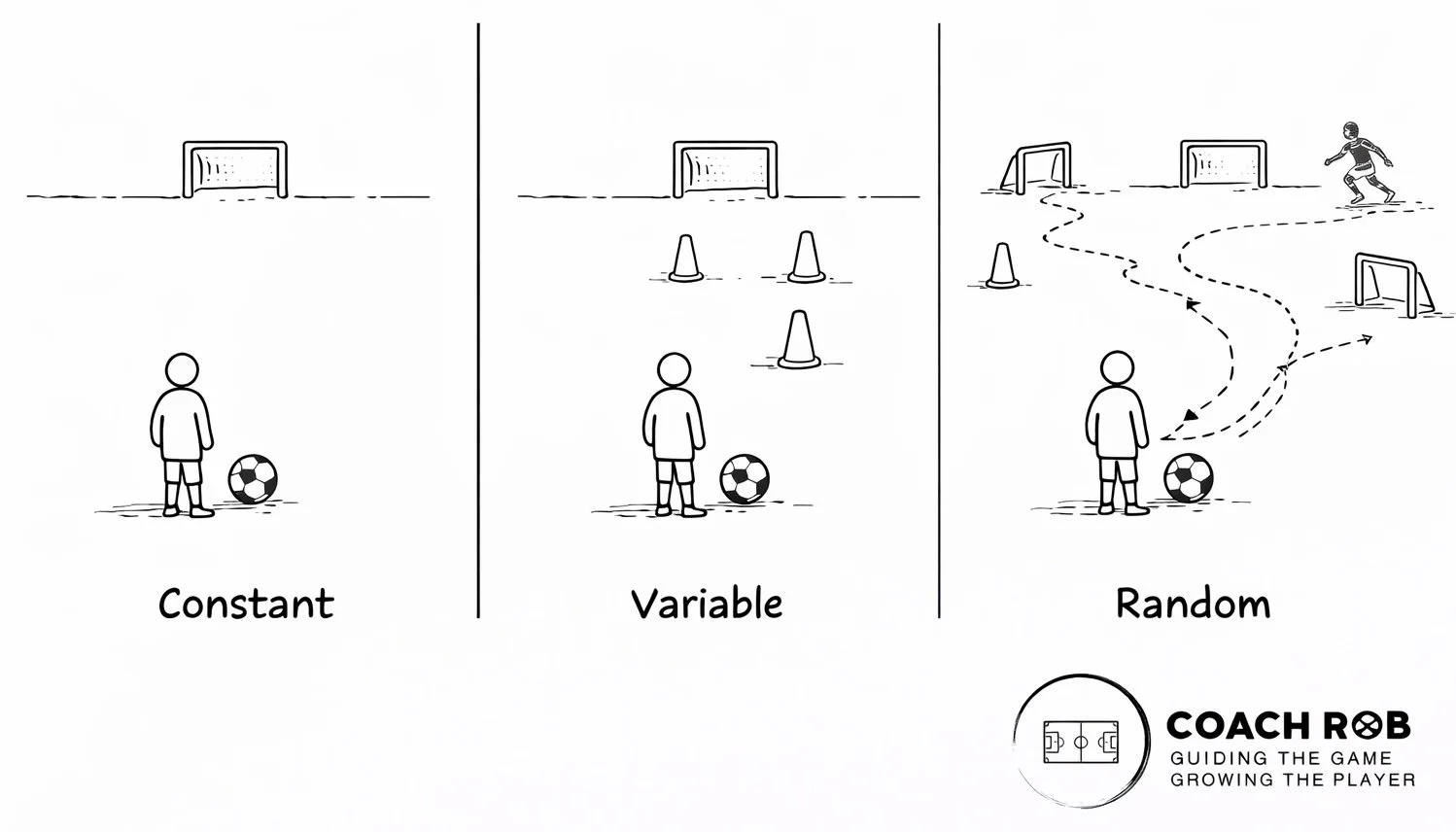
Constant practice
Stable environment, low information
In constant environments:
The setup stays the same
The outcome is predictable
The player knows what is coming
This places the main demand on execution.
Constant practice helps players:
Stabilise basic movement patterns
Build coordination
Gain early confidence
This is particularly important in smaller formats like 7v7, where players are still learning how their body, the ball, and space interact.
However, constant environments tell us very little about how a skill will survive pressure.
Variable practice
Changing conditions, growing adjustment.
In variable environments:
The skill stays the same
One or more conditions change
This introduces:
Adjustment
Simple decisions
The need to modify execution
Here, decision-making becomes more demanding, even though the information is still constrained.
Mistakes often increase at this stage.
This is not a sign the skill is disappearing — it’s a sign the skill is being stretched.
Random practice
Unpredictable environment, game-like demand
In random environments:
Conditions change continuously
Multiple options exist
Pressure arrives unexpectedly
This is where:
Perception becomes the limiting factor
Decisions must be made earlier
Execution happens under time and information stress
Random environments most closely resemble the game.
Performance often looks worse here — slower, messier, less consistent — but this is where skills begin to transfer.
How CVR connects to Perception → Decision → Execution
Every football action follows the same thinking process:
Perception → Decision → Execution.
What CVR changes is where the main load sits.
Constant environments are execution-dominant
Variable environments increase decision demand
Random environments fully challenge perception, decision, and execution together
All three parts are always present.
What shifts is which part becomes the bottleneck.
This explains why skills that look stable in calm conditions can break down under pressure — nothing has been lost, the problem has simply become harder.
Why this progression fits 7v7 particularly well
In 7v7 football, players are:
Newer to game information
More sensitive to overload
Still developing coordination and awareness
Using constant, variable, and random environments allows coaches to:
Gradually increase thinking demands
Avoid overwhelming perception too early
Prepare players for more complex formats later
CVR is not about delaying challenge.
It’s about graduating challenge.
A useful reframe for coaches
Instead of asking:
“Why can’t they do this consistently yet?”
Try asking:
“What kind of environment is this skill being asked to survive in?”
Consistency does not come before adaptability.
It emerges because of it.
The key idea to hold onto
Football skills are not fixed techniques.
They are actions that must survive:
Different spaces
Different pressures
Different decisions
Constant, variable, and random practice help explain why performance changes — and why those changes are often a sign of progress, not regression.
How this connects forward
This concept underpins:
Why mistakes increase during good learning phases
Why skills look different in games than drills
Why perception becomes more critical as formats grow
Why Guided Discovery becomes more important in 9v9 and beyond
CVR explains how environments load thinking.
Guided Discovery explains how coaches support that thinking without taking it away.Why practice environment matters
When coaches talk about skill development, they often focus on what is being trained.
Just as important is the environment in which the skill is practiced.
A pass practiced in a calm, predictable setting is not the same skill when performed under pressure, with multiple options and limited time. The movement may look similar, but the demands on perception, decision-making, and execution are very different.
This is where constant, variable, and random practice help us understand how skills are built — and rebuilt — over time.
