
Perception, Decision, Execution (PDE)
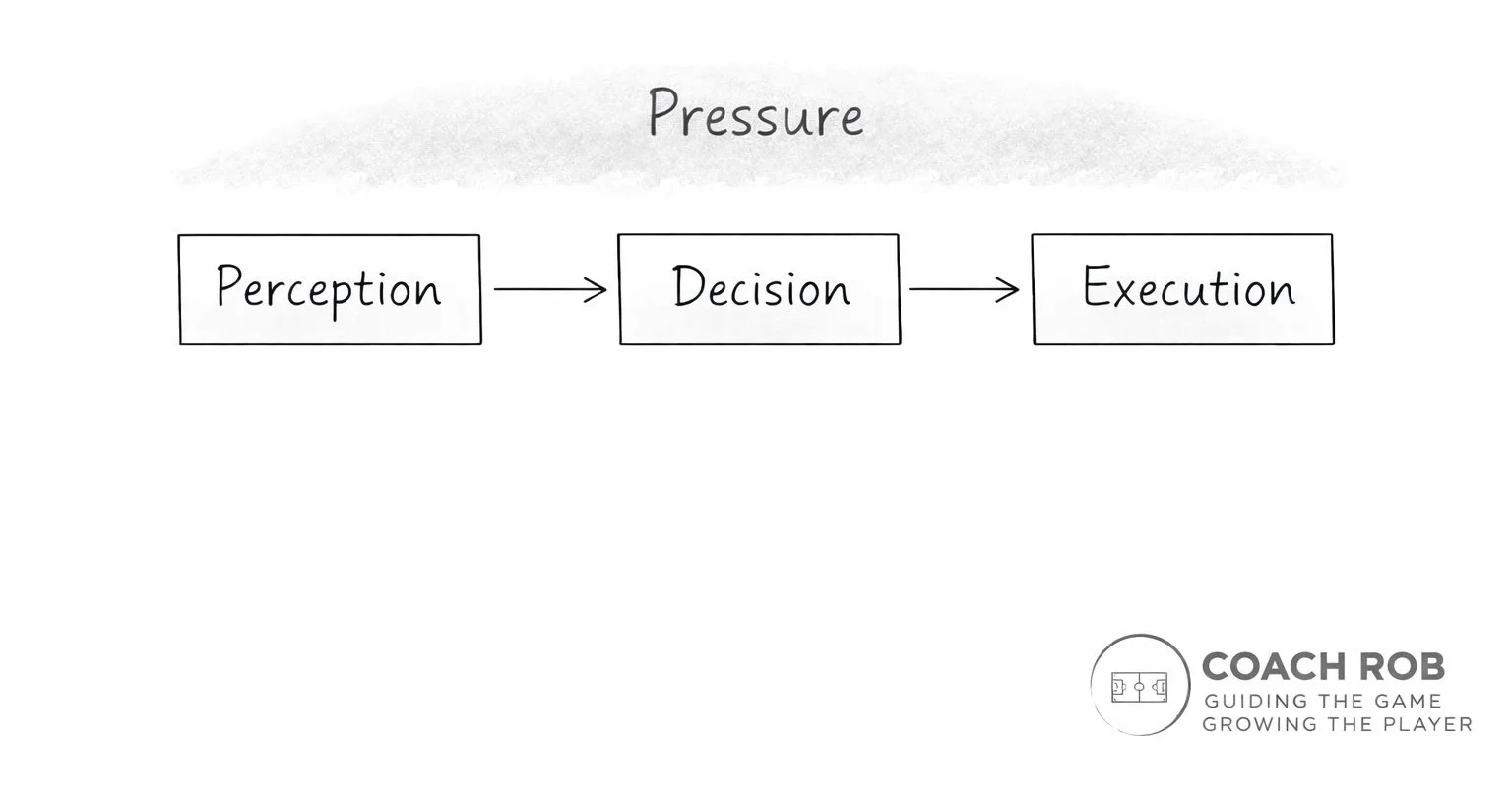
The Perception, Decision, Execution cycle
Why skills break down in games
Most coaches recognise this moment:
“They can do it easily at training — why does it fall apart in a game?”
The usual explanation is technical.
But in football, execution is rarely the first thing to fail.
More often, the breakdown happens earlier — in what the player sees, processes, and decides before the action takes place.
This is where the Perception → Decision → Execution (PDE) model helps make sense of what we’re seeing.
The Perception → Decision → Execution cycle
Every football action follows the same basic thinking sequence:
Perception – What information does the player notice?
Decision – What option do they choose?
Execution – How well do they perform that action?
This cycle repeats constantly, often in less than a second.
When it flows, the game looks calm and connected.
When it breaks, it looks rushed, messy, or panicked.
If perception or decision is compromised, execution rarely survives.
Perception: what the player actually sees
Perception is not simply “looking up”.
It’s the ability to notice relevant information at the right time:
Where pressure is coming from
Where space is opening or closing
What teammates and opponents are doing now, not a moment ago
For young players, this is difficult because:
Attention is naturally narrow and ball-focused
Information processing is slower
Emotion, fatigue, and noise reduce awareness
So when we ask players to “just look”, we’re often asking for a skill that is still developing.
Perception is not a switch. It’s a capacity that grows gradually with experience.
Decision: choosing between imperfect options
Once something is perceived, a decision must follow.
In football, decisions are rarely clear-cut. Players are choosing between:
Speed and safety
Risk and reward
Holding the ball or releasing it early
Young players don’t lack ideas. They lack experience solving these problems under pressure.
That’s why decisions often look rushed or inconsistent — not because players aren’t thinking, but because they are thinking with limited information and time.
Execution: the visible part we judge
Execution is the part we see most clearly — and judge most harshly.
But execution depends on:
What the player perceived
How quickly a decision was made
Balance, confidence, and emotional state
A technically sound action can fail if the decision is late. A good decision can still look messy under pressure.
Execution is the outcome of the thinking process, not the start of it.
Why pressure changes everything
As pressure increases:
Information arrives faster
Time to decide decreases
Perception narrows
This is why players:
Panic in games
“Forget” skills they show in training
Make mistakes they don’t usually make unopposed
Nothing has disappeared. The environment has simply become more demanding.

How this looks across game formats
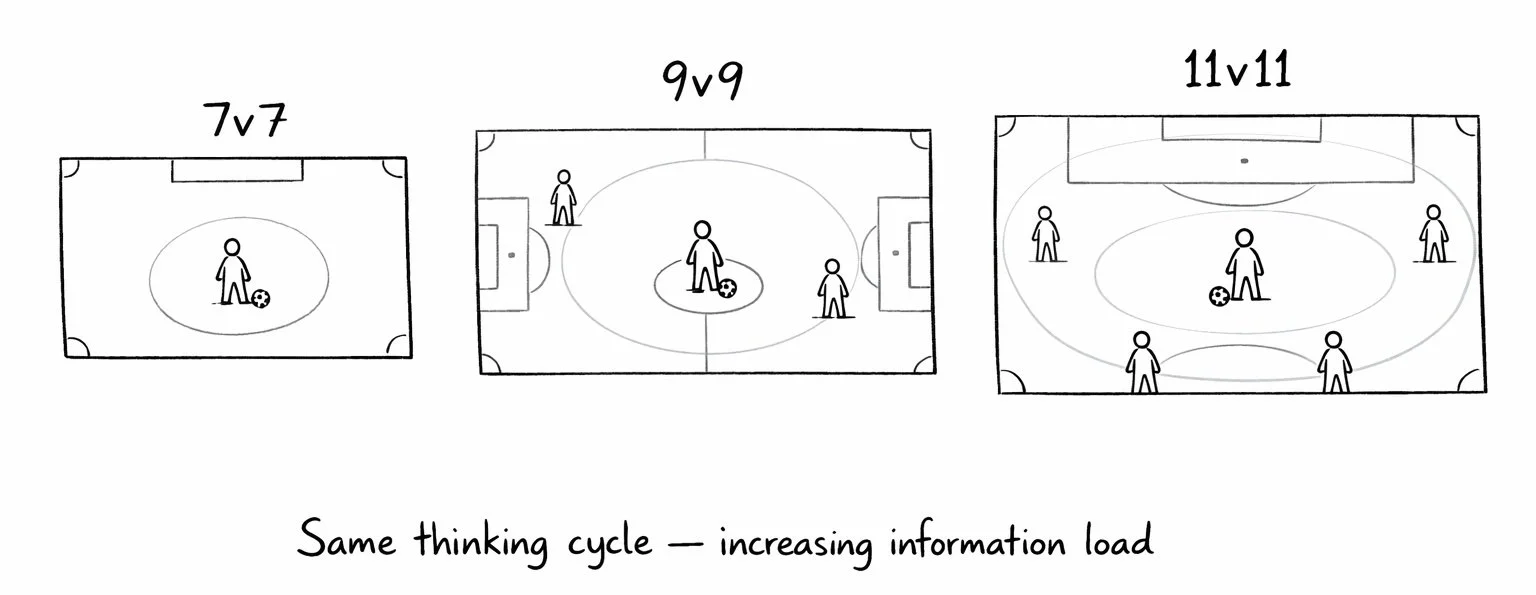
The PDE cycle exists at every level — but the information load changes as the game grows.
In 7v7, perception is mostly local and immediate. Decisions are simple and often reactive.
In 9v9, players must notice more — teammates further away, defensive shapes, emerging space. Decisions need to happen earlier.
In 11v11, perception becomes continuous scanning. Decisions are influenced by team structure and what might happen next, not just now.
The thinking process stays the same. Only the complexity increases.
A familiar match-day moment
A midfielder receives the ball, turns, and immediately loses it under pressure.
From the sideline, it looks like a poor decision.
But often the real issue occurred earlier. The player didn’t perceive the defender arriving because their attention was fixed on controlling the ball. The decision to turn wasn’t reckless — it was uninformed.
The execution simply revealed the earlier breakdown.
A useful coaching reframe
Former Arsenal manager Arsène Wenger once observed that football is often taught the wrong way around - execution first, perception last.
A calmer reframe is this:
When mistakes happen, the question is rarely “can they do it?” More often, it’s “what were they trying to solve?”
This shift alone changes how mistakes are interpreted.
The key idea to hold onto
Most football mistakes are not technical first.
They are usually:
Perception problems → decision problems → execution symptoms
When coaches understand this, frustration drops. Judgement softens. And learning becomes easier to recognise.
How this article connects forward
This concept underpins:
• Training session design
• Match-day feedback
• Supporting players under pressure
• Understanding confidence, emotion, and attention
You’ll see Perception → Decision → Execution referenced throughout The Training Shed and The Tactics Board.
