
Every Saturday morning, a few thousand kids pull on boots that are slightly too big and chase a ball around a field while their parents stand on the touchline reading the weather, the score, and their own child's face all at once.
I've spent a good few seasons on that touchline now — as a coach, and as a parent. Coach Rob is what came of it.
About Me
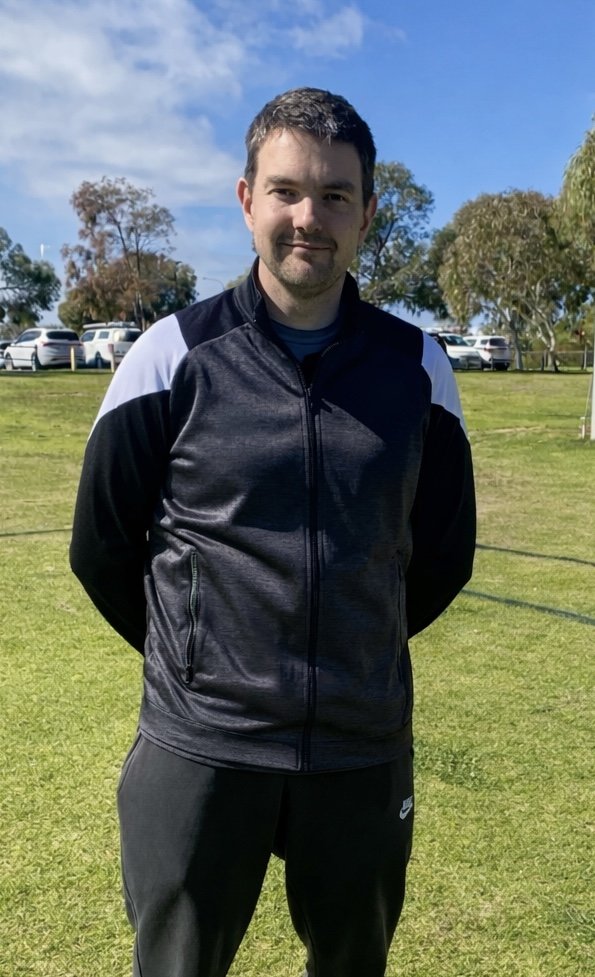
My name's Rob. I'm a GP in Perth, Western Australia, which is a long way from where this story starts.
I grew up in England, and I was not a sporty child. I was overweight, not especially fit, and I went in goal because that is where my friends decided the fat kid belonged. The strange part is that I came to love it. The less strange part is that nobody ever taught me the basics, and no coach ever made me feel they believed in me. I joined a team and sat on the bench behind the coach's son. I drifted away from the game.
I tried again at university — turned up to find four other goalkeepers already there, had a rough afternoon in a shooting drill, and quietly drifted away because nobody was managing the psychological side of the game. That afternoon taught me exactly how fragile a player's confidence can be—and how easily a coach can shatter or save it. There was a bit of five-a-side after graduation, until work made even that difficult. What never left was the love of it. I spent a frankly unreasonable number of hours playing Football Manager, watching youth players grow into first-team players and working out why one shape beat another.
Then we moved to Australia, and the game found me again through my son.
My eldest didn't take to football at first — a few sessions of Grasshoppers and that was that. When he came back to it later, I pushed him to try outfield rather than in goal. I wanted him to have a different experience to me. We were told in the school playground by another parent that he would outgrow Grasshoppers and should find a club. My wife rang around, Kingsley Westside came recommended, and she told them her husband liked football and could help. That was news to her husband! I was coaching the purple team within the week.
I had no real idea what I was doing. I made every mistake going — drills far too tactical for nine-year-olds, skills I couldn't demonstrate cleanly myself. But I could talk to the kids in a way that made them feel respected and believed in, and that turned out to matter more than the rest of it. So I set about getting better. I worked through Football Australia's coaching pathway, coached Under 9s and Under 10s at Kingsley Westside.
We didn't win a great deal — partly because I refused to sacrifice player rotation and development just to chase a one off victory at U9. Looking back, that was incredibly useful. It forced us to measure success by how much the kids improved, rather than the scoreline. It forced me to ask questions.. The trouble was finding answers. Coaching advice, when I could find it at all, tended to be opinion or a YouTube clip rather than a reason. Coach Rob is my attempt to do something about that.
As for my son: he ignored my advice entirely and is a goalkeeper. He is currently playing for Mindarie U11, where I now support the Under 11s and goalkeepers. He is very good — better than I ever was. I have made my peace with both of those facts.
Why this exists
There is no shortage of information about youth football. There is a shortage of someone sitting beside you and explaining what it means.
Parents are told their child should be doing more — more clinics, more touches, more competitive games — usually by someone with something to sell. Coaches are handed a rulebook and a bag of bibs and left to work out the rest alone, often without a single colleague to think out loud with.
Coach Rob exists to close both of those gaps. Not with hot takes or highlight reels — with plain explanations of why youth football is built the way it is, and what that means for the decision in front of you this week.
A word on where I stand, because it shapes everything here. I don't think youth football is a production line for professional players — the maths alone makes that a poor reason to turn up. I think it's where a child learns to try something, fail at it in front of people, and come back the next week anyway. The game should still make sense to them at sixteen, and at twenty-five. The score on a given Saturday is the least interesting thing about it. The child always comes first — before the team, the tactics, the table.
Two sides to the site
Over a couple of seasons I noticed I kept hearing the same two sets of questions. Parents wanted to know whether what they were watching was normal. Coaches wanted to know what to actually do on Tuesday night. So the site is in two halves.
Touchline Talk is for parents. It's about understanding what you're watching: why the score doesn't matter yet, why your child plays four positions across a season, why the coach took them off the moment they were finally enjoying it. It's written to leave you calmer and clearer than when you arrived.
The Coaching Ground is for coaches. Less reassurance, more toolkit — frameworks, training ideas, and the occasional argument about how the game should be taught. It's for anyone trying to make sense of the game and teach it a little better each week, whether you've done your badges or were handed the bibs last Thursday.
You're welcome in both. Plenty of people read a parent piece and a coaching piece in the same sitting. That's rather the point.
A few honest notes
Coach Rob isn't a governing body, a club, or an official anything. For the actual laws and formats where you play — MiniRoos and junior football — your federation's published rules are the source of truth.
Nothing here is medical advice. On concussion in particular, "if in doubt, sit it out," every time.
And I'm not selling a method. If an article ever reads like it's trying to sell you something, I've got it wrong — and I'd want to know.
Get in Touch
If any of this sounds useful, the best thing you can do is to contact me.
Otherwise — enjoy the football. They're only this age once, and the muddy boots in the hallway don't stay there forever.