Taking the Whistle
Someone taps you on the shoulder. The club is short a referee (aka Game Leader) this Sunday. You've watched enough of it — surely you know the rules well enough.
And then the dread arrives.
Not the rules themselves. The spotlight. Getting something wrong in front of forty people. The coach on the far touchline who appeals every second decision. The parent absolutely certain about every foul.
What I've learned since is that the dread and the difficulty are two separate things. The difficulty is mostly about what nobody tells you in advance.
The Essentials
You are a Game Leader, not a referee. That's the official title and it's meaningful. Your job is to keep the children safe and the game moving — not to officiate the full Laws of the Game.
The rules are simpler than you fear. No offside is called at any MiniRoos age. Most restarts are simpler than you expect, and your club's MiniRoos rules sheet covers the small local differences.
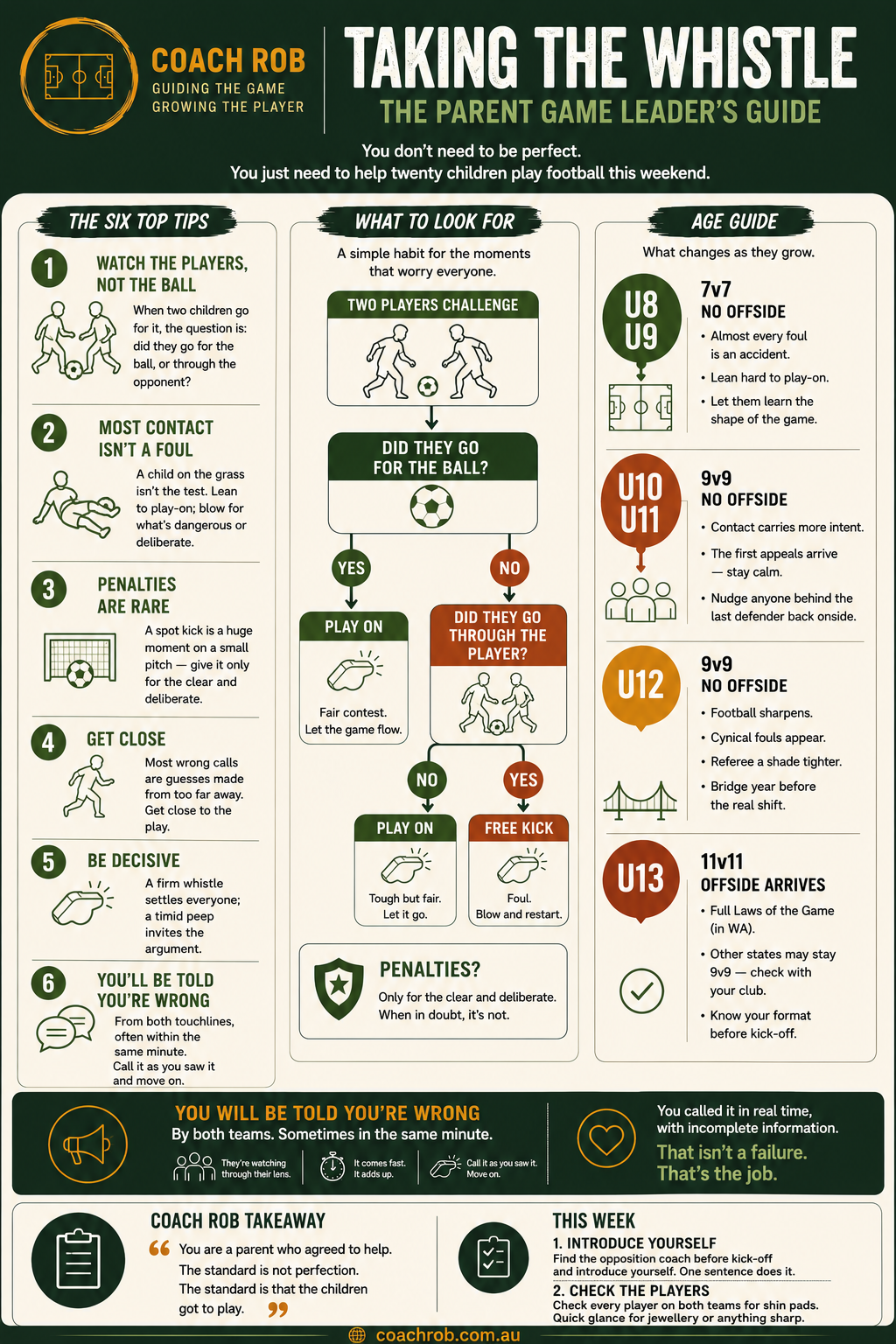
Watch the players, not the ball. When two children go for it, the ball stops being where the decision is. The one question that sorts almost everything: did they go for the ball, or through the opponent?
Most contact is not a foul. Children are still learning to control their bodies. Lean toward play-on. Blow for what is dangerous or deliberate.
You will be told you are wrong. From both touchlines, repeatedly, often within the same minute. Call it as you saw it and move on.
The Deep Dive
A few minutes of preparation will save you twenty minutes of stress.
Arrive fifteen minutes early and find the opposition coach before their team talk — not during it — and introduce yourself. One sentence does it: “I'm running the game today, just wanted to say hello.”
Check that every player is wearing shin pads before kick-off — and have a quick look for jewellery, watches or anything sharp. This sounds basic, and it is, but it's your responsibility.
You blow the whistle for the start of each half, after a goal, and for fouls. For everything else — throw-ins, corners, goal kicks, restarts — you point in the direction of the team taking it and let play continue.
What Counts as a Foul
The part that actually worries people is deciding what's a foul. The reassuring thing is that the judgement barely changes from U8 to U12 — what changes is the children, not the rules. The hardest moment is the half-second when two players arrive together and everyone looks at you. The habit that gets you right more often than wrong: watch the ball until two players commit to it, then take your eyes off the ball and onto them. The foul, if there is one, happens to the player — not to the ball you were following.
Then ask one question: did the child go for the ball, or through the opponent? Two kids tangling and both ending up on the grass is a fair contest — a child falling over is not the test. You're watching for the moment someone stops playing the ball and starts playing the body — a shove in the back, a shirt held, a leg left in after the ball has gone — and for anything that could hurt a child, which gets the whistle every time.
The children will often tell you themselves. After a fair challenge they bounce up and chase the next ball; after a real foul, everyone stops and turns to look at you. If the players have already moved on, that's usually your sign that you can too
One last thing nobody mentions: most wrong calls are guesses made from too far away. Stay within shouting distance, keep a slight angle, and you'll see the gap between the two players. That gap, not the ball, is where fouls live. And when you do blow, blow it like you mean it: a firm whistle settles everyone, where a timid peep just invites the argument.
Free Kicks & Penalties.
Free kicks and penalties both come from a foul, so they belong here. The free kick is the everyday one — and at these ages it's indirect, which means a goal can't be scored straight from it; the ball has to touch a second player first.
I learned that one the hard way. In my first year of coaching we won a free kick, and one of our players hit a rocket into the top corner; we celebrated like we'd won the league. At training the following week our junior VP wandered over: "I heard your team scored a free kick on Sunday — yeah, that's not allowed." It took a little shine off the win, but I never forgot it again. As the one holding the whistle, it's worth knowing: a screamer struck straight from a free kick isn't a goal.
The penalty is the call to be slow with. A spot kick is a huge moment on a small pitch, and a young side that goes behind to one they feel was unjust can deflate for the rest of the half. Give it only for the clear and deliberate — a real push, a deliberate trip, a hand that genuinely stops a goal. And here's the part that takes the pressure off: a foul in the box doesn't have to be a penalty. For the borderline ones, you can give an indirect free kick inside the area instead — the gentler option is always there.
And they remember. Two seasons on, I still hear about a penalty one team felt was unfair — children carry these far longer than any adult expects.
Did the Ball Cross the Line?
You're one person, not three, so often you simply won't have seen it. When that happens, give the throw, point with conviction, and move on — and if you point one way but all ten of them turn and run the other, trust them. At this age they usually know whose touch it was better than you do, and a throw-in the wrong way is the smallest mistake on the pitch.
Throw-ins, Corners and Goals.
These are the calls both teams tend to shout for at once — out wide especially, with players strung along the line and one child yelling "out!" while the rest play on. The whole ball has to cross the whole line. If any part of it is still over the line, it's in — even when it looks out from where you're standing.
The catch is you can't judge a line from side-on; from across the pitch, a ball near the touchline will fool you every time. Get roughly level with it and look down the line, not across it.
Goals are the hardest version of the same call, and there's no goal-line technology out here. On-the-line decisions are genuinely tough, and sometimes you just won't be sure. When it isn't clear, I tend to give the goalkeeper the benefit of the doubt — they're closest to the ball and usually know whether it crossed. If in doubt, I lean toward not giving it.
By Age Group
U8 and U9
Seven-a-side, and the youngest you'll referee. At this age almost every foul is an accident — a mistimed run, a tangle of feet, a swam of kids to the ball, a handball nobody saw coming. The deliberate, tactical foul barely exists yet, so lean hard toward play-on and save the whistle for what's genuinely dangerous. The football itself will be scrappy: throw-ins go astray, restarts stall. If a child fumbles a throw, let them pick it up and try again rather than handing it straight to the other team — and a quiet "ready, set, go" does more to keep things moving than any ruling. They're still learning the shape of the game, and so are you.
U10 and U11
The game grows to nine-a-side on a bigger pitch, with longer halves and a heavier ball. The contact carries a little more intent now, and you'll meet the first real appealing — a hand up, a shout of "handball!", a glance to see what you'll do. Answer it once and move on: "I've seen it — play on." Don't be drawn into a debate; a calm word settles it faster than a ruling. Offside still isn't called, but this is the age the children start being taught it, so you'll quietly nudge anyone loitering in a blatant offside position back onside rather than letting them camp on the last defender.
U12
Still nine-a-side, still no offside formally called — on paper, almost identical to U10/U11. What changes is the football, not the rulebook. Players are quicker and more deliberate, and the cynical foul turns up for the first time: the shirt tug on a breakaway, the body shoved across to kill a run. Most of them know exactly what they've done. This is where you keep the spirit of offside alive — they're expected to understand it by now, so you nudge the blatant positions back onside and let the rest play, because at U13 it becomes a real call and they're being readied for it. It's the bridge year: fair to referee a shade tighter than you would the little ones.
U13
This is the real shift. In Western Australia the game moves to eleven-a-side on a full pitch, offside arrives as a proper call, and the fouls list aligns with the full Laws of the Game. Other states hold nine-a-side a little longer — so check with your club which format you're running before kick-off.
“You are a parent who agreed to help. The standard is not perfection. The standard is that you turned up, you tried your best, and the children got to play. That is the whole job, and it is enough”
Every game throws up moments where the rulebook is silent and the touchline is loud. I refereed a friendly U11 game. Early on, the ball struck a defender's arm in the box; the opposition screamed handball and I waved it on, in my view entirely unintentional. Minutes later a pass hit one of our players on the arm and I gave it — our players appealed instantly, that was never handball. Then an accidental pass-back to the goalkeeper at their end I let go as borderline; an identical one at our end I also let go, and said so when their coach questioned me. The reply came back: that wasn't a pass-back.
By that point I'd been told I was wrong four times in twenty minutes — twice for making a call, twice for not. That's the part that stays with you: not any single decision, but the accumulation. Each team saw the same moment through a completely different lens, and both were certain. You are the only person on or around that pitch without one.
You called it as you saw it, in real time, with incomplete information. That is not a failure of preparation. That is the job.
And you'll miss one — the clip you didn't see, the handball everyone else spotted, the corner you gave the wrong way. What happens next is almost always nothing. The game carries on, the children adapt, and five minutes later you're the only person still thinking about it. The mistake feels far bigger to you than it does to anyone else.
The Takeaway
Mindset Shift: You're not refereeing a professional match. You're running a game so that twenty children get to play football this weekend — and the clear calls announce themselves. Trust your eye.
This Week: If you're running a game soon, do two things in advance. Find the opposition coach fifteen minutes before kick-off and introduce yourself. Then check every player on both teams is wearing shin pads.