
The U8 Guide — Outfield
The Knowledge Net · Reference Guide · The Coaching Ground
Playing context: MiniRoos, Western Australia. 7v7.
The age shows when an idea becomes the primary focus — not when it first appears, and not when it is finished. This is the Coach Rob developmental map: one primary focus per age, not an official syllabus or the only valid sequence.
U8 is the first year of seven-a-side football. A goalkeeper, a penalty area, a pitch with a shape to it. Most of what a child does this year, they do alone.
Principles of Play: Penetration and Delay
Penetration is getting past an opponent towards their goal. Delay is its twin: slowing an opponent down rather than trying to win the ball immediately.
Both are actions. One player, right now, this moment. That is the shape of the U8 year, and it is worth knowing the team principles arrive later so you are not disappointed by their absence.
Penetration is not only dribbling
A forward pass penetrates. So does a run with the ball, and so does a shot. At U8 the dribble is the most common version simply because carrying the ball lets a seven-year-old see the defender and solve them at their own speed.
The question is not which one they chose. It is why. A forward pass that improves the attack is penetration. A sideways pass played because holding the ball felt uncomfortable is something else — and the difference is visible from the touchline once you look for it.
Let them try to beat people. A seven-year-old who loses the ball going past someone is doing the right thing badly, which is what you want at this age.
Delay is not permanent non-tackling
The instinct at U8 is to sprint at the ball and lunge. Delay is the correction, and the full sequence is: close quickly, slow down as you arrive, stay on your feet — then challenge when the ball gets away from the attacker.
That last part matters. A child taught only to stand off becomes a child who never wins the ball. The tackle is not banned; it is postponed until the touch invites it.
You need no cover, no angles and no second defender to teach this. One child, one opponent, one job.
Coaching it
In training: one-against-ones, endlessly, in every direction. Small pitches. Everybody on a ball.
On match day: the picture is small enough for a brief immediate cue. "Can you go forward?" and "slow them down" both work.
What to leave alone is the choice inside it — which move, which pass, the exact moment to tackle. Those are the child's, and they are the whole point of the year.
At U8, the names belong to the coach
The children need the game and one short cue. They do not need a lesson on principles, and nobody is asking a seven-year-old to say the word penetration.
Where the focus goes next
A second player joining in — support and cover — becomes primary at U9. It appears this year whenever two children happen to be near each other, and there is no reason to stop it.
On the Training Field
The pedagogy at U8 and U9 is coordination and variability: lots of touches, lots of different movements, not much instruction. The aim is a body that can do things, not a head full of concepts.
Technique for penetration:
Running with the ball, head up when they can manage it, both feet.
The change of direction — inside hook, outside hook, drag back. Two or three moves owned beats ten half-learned.
The change of pace, which is what actually beats a defender. Most children have the move and not the acceleration after it.
The short forward pass, so that penetration has more than one form.
Shooting when the goal opens, without waiting for a perfect chance. Penetration ends in a shot, and a child who will not shoot has not finished the principle.
Technique for delay:
The approach — fast to close, slow to arrive.
The side-on stance, so you can move either way.
Staying on your feet until the touch is loose.
The challenge itself, when it comes.
Practices: 1v1 gates. 1v1 to two small goals. Waves of 1v1s with a queue behind each. Anything where a child has to beat a person rather than a cone.
On losing the ball. They will, constantly. Do not make the loss the lesson. Results aren’t formally recorded, and the children will keep score whatever anyone says — the score is not the development measure this year, and a child who learns not to try will cost you far more than a goal will.
Match Day: The 2-3-1
One tactical shape. Rotate the roles every few weeks — at U8 more than at any other age.
7v7: 2 defenders, a midfield, 2 wingers, and a striker.
Why this shape at U8. It gives every child a spot to come back to when the game becomes a swarm, which it will several times a half. It is not a tactical instruction. It is a home address.
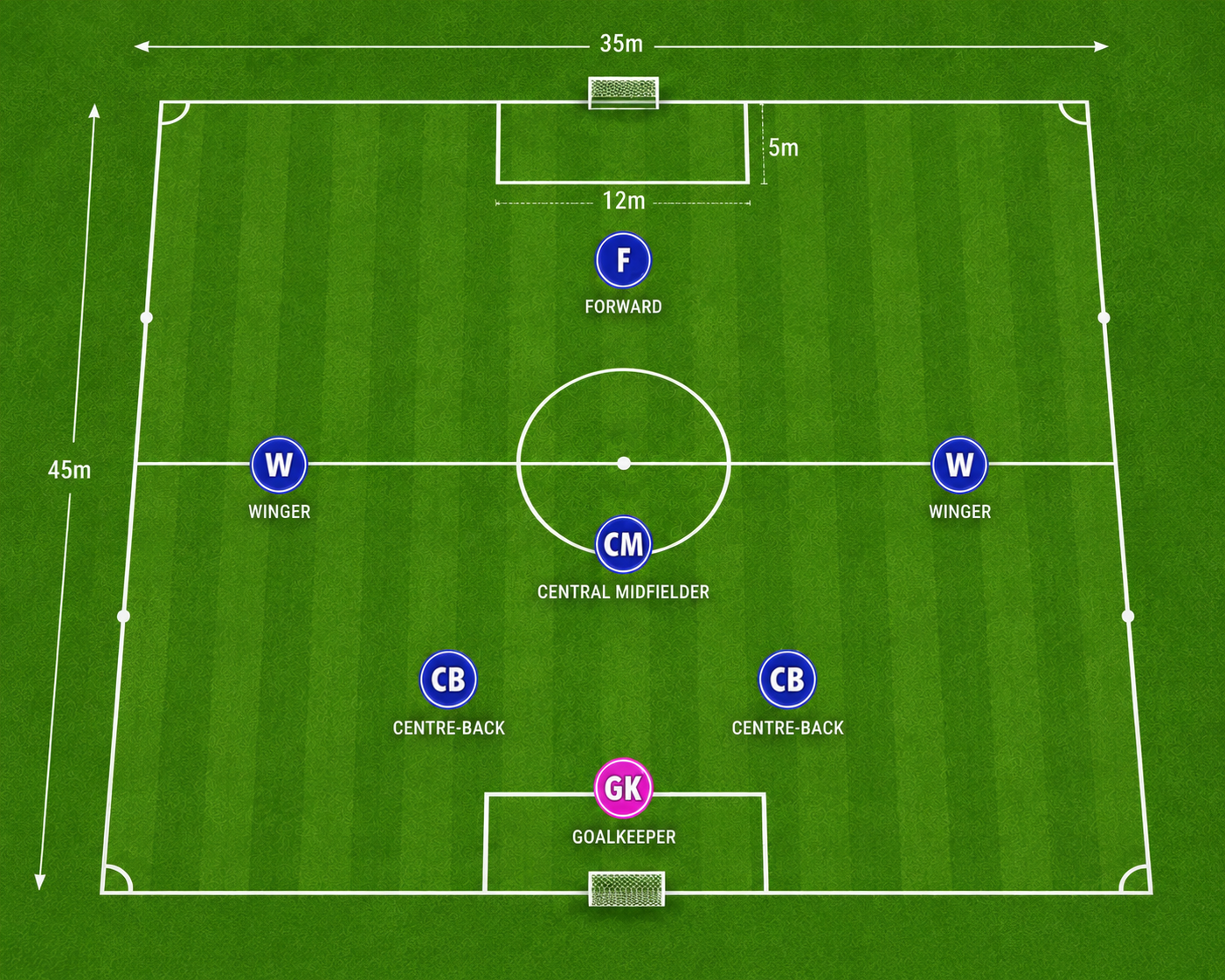
In possession. On a goal kick, opponents stand ten metres outside a penalty area, so the ball starts in roughly fifteen metres of space. The two defenders spread. The central midfielder shows. The wingers go wide, largely so that somebody is not in the middle.
Out of possession. The nearest player delays. That is the defensive plan and it is enough.
Give the players home positions and a simple direction to recover towards — but do not spend the season trying to hold a coordinated defensive block. They cannot yet see the picture it depends on.
What goes wrong: everybody follows the ball, which is normal and not evidence that the shape has failed; the striker stands still up front; a defender never crosses halfway. The last one is worth fixing, because a child told to stay back at seven will still be doing it at twelve.
Carrying forward. U9 uses the same shape and the same format, with a second player added to every picture.